

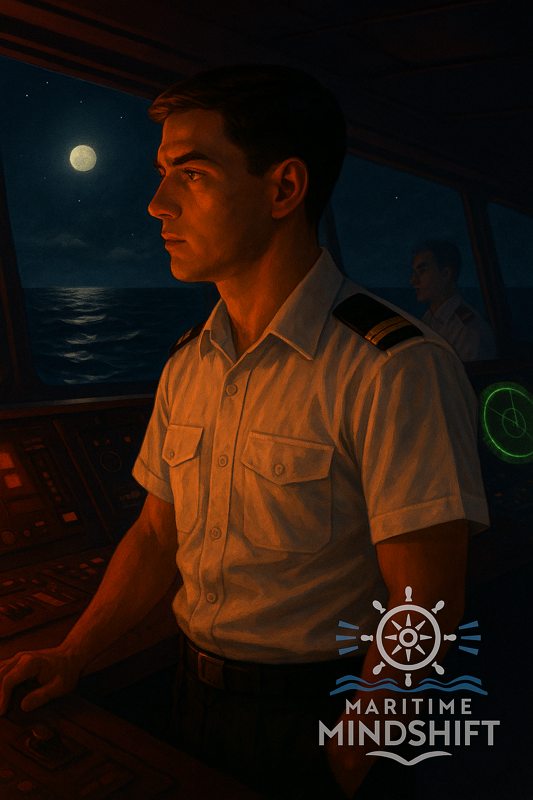
📍Some lessons don’t come with slides—they come with silence, stars, and sweat.
You can prepare for storms, drills, and exams. But nothing prepares you for the moment you realize you’re alone on the bridge… and everyone’s safety depends on you.
🌊 The cadet, the clock, and the current
It was a moonless night somewhere in the Gulf of Mexico. Cadet Ignacio had just started his 0000–0400 watch. The officer on duty, a calm second mate, was nearby, but had stepped inside the chart room for a few minutes. That’s when the radio hissed:
“Bridge, this is Engine Room. We’re switching to auxiliary pump. You may notice a brief change in steering response.”
Ignacio acknowledged and returned to scanning the radar and visual horizon. A bulk carrier was approaching on the port quarter—nothing alarming yet, but close enough to monitor.
Minutes passed. Then the ship began to veer slightly starboard—nothing huge, but noticeable. Ignacio checked the gyro. Everything looked normal. He gently adjusted course.
The second mate returned and noticed the heading drift. “What happened?”
Ignacio explained. The mate didn’t scold him. He just pointed to a dry-erase board behind the helm:
“Be alert to subtle changes—small errors multiply at sea.”
That phrase stuck with Ignacio.
Later, back in his cabin, he couldn’t sleep. Not because he’d made a mistake—but because for the first time, he understood the weight of watchkeeping. This wasn’t a simulation. It was real navigation, real accountability, and a real ship that could drift into danger because of a small oversight.
He had done okay. But he also saw how easy it was to let “almost nothing” become “almost too late.”
That watch changed how he approached his training. No more passive learning. No more zoning out in bridge class. He paid attention to tones in the radio, wind speed fluctuations, ship vibrations. He began treating every minute on watch like a decision point.
Years later, as a second officer himself, he told cadets under his charge:
“The bridge may be quiet, but never be passive. The sea never sleeps.”
🧭 Practical Lessons from This Voyage
- Small details create big safety margins. Reacting late to subtle cues is how accidents begin.
- Confidence without vigilance is a trap. Alertness is a daily habit, not a burst of brilliance.
- Every quiet night is still a test. The calm sea is not a break—it’s an invitation to sharpen your senses.
⚓ Learn What They Don’t Teach in Class
Not all maritime lessons are in textbooks. From Cadet to Captain – Vol. I shares the insights forged in real watches, real bridges, and real storms.
👉 Get your copy on Amazon and start thinking like an officer—even before you wear the stripes.
📘 Want more stories forged in real pressure?
🔻🔻🔻🔻🔻🔻🔻🔻🔻🔻🔻🔻🔻🔻🔻

📬 Love all things maritime? Get exclusive stories, practical tips, and leadership insights delivered straight to your inbox—subscribe now!!!
We send out regular insights, regulation changes, and practical guides for cadets and seasoned officers alike.
🔻🔻🔻 Fill out the form below and stay connected with Maritime Mindshift.🔻🔻🔻
📢⚓ Calling All Maritime Enthusiasts!
📝📸 Have an article, story, or photo to share? Send your submissions to contact@maritimemindshift.com and get featured on our blog!
🌊🚢 Join the crew—let’s navigate new horizons together!

Deja una respuesta