

For more than a century, the maritime industry has run on heavy fuel oil — dense, dirty, and cheap. But the winds are shifting fast. With new IMO regulations, carbon pricing, and mounting pressure from clients and financiers, shipowners are looking for something radically different: a fuel that can move the world without heating it up.
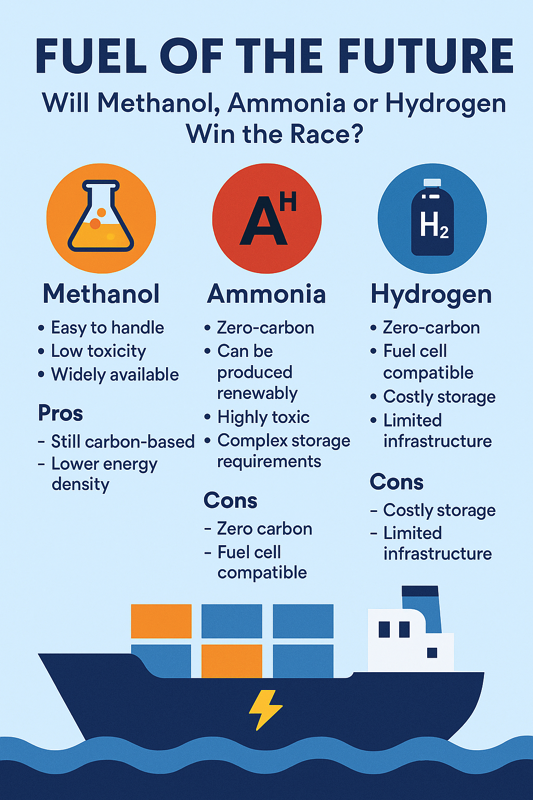
Among all the contenders, three names stand out: methanol, ammonia, and hydrogen. Each promises cleaner operations, fewer emissions, and a shot at true decarbonization. But which one will dominate the future of maritime propulsion? Let’s break down the race.
🧪 Methanol: The Quiet Front-Runner
Methanol isn’t new — it’s been used in cars, chemicals, and industry for decades. What’s new is how quickly it’s gaining ground in shipping.
Why? For starters, methanol is liquid at ambient temperature, making storage and bunkering far simpler than hydrogen or LNG. It can be produced from natural gas (gray methanol), biomass (bio-methanol), or even captured CO₂ and hydrogen (e-methanol), offering a path to carbon neutrality.
Several major operators, including Maersk, are already investing heavily in methanol-powered ships. The engines are available. The infrastructure is developing. And unlike ammonia, methanol doesn’t smell like catastrophe.
Pros:
- Easy to handle and retrofit
- Relatively low toxicity
- Available today
Cons:
- Still carbon-based unless fully green
- Lower energy density than traditional fuels
💥 Ammonia: High Risk, High Potential
Ammonia has one massive advantage: it contains no carbon at all. When burned, it produces only nitrogen and water vapor — no CO₂. That makes it a dream fuel for regulators focused on climate targets.
But the dream has a catch: ammonia is highly toxic, corrosive, and volatile. Engine technology is still catching up, and safety procedures must be airtight. One leak in a confined space, and you’ve got more than downtime — you’ve got a serious health emergency.
That said, research is advancing fast. Several shipyards and classification societies are testing ammonia-ready designs. If safety and efficiency hurdles are overcome, ammonia could become the long-range zero-carbon champion of deep-sea shipping.
Pros:
- No carbon emissions
- High energy potential
- Can be produced renewably via green hydrogen
Cons:
- Toxic to humans and marine life
- Engine and safety tech not fully mature
- Complex storage requirements
💧 Hydrogen: The True Zero, With Big Barriers
Hydrogen is often hailed as the “fuel of the future” across industries — and for good reason. When used in fuel cells, it emits only water. No carbon, no particulates, no sulfur. It’s also incredibly versatile: usable in combustion engines, gas turbines, or electrical systems.
But in shipping? Hydrogen faces a storm of challenges. It must be stored at extremely low temperatures or high pressure, which is a nightmare for onboard safety and design. Its energy density per volume is low, making it hard to justify on large oceangoing vessels. Still, for short-sea shipping, ferries, and port operations, hydrogen may be the quiet revolution already underway.
Pros:
- True zero-emission potential
- Works with fuel cells for high efficiency
- Scalable across transport modes
Cons:
- Complex and costly storage
- Infrastructure barely exists
- Still produced mostly from fossil fuels
🧭 So… Who’s Winning?
The answer, for now, is: no one — and maybe everyone. The shipping world is vast and varied. What works for a container giant may not work for a coastal ferry. The future likely holds a multi-fuel landscape, shaped by region, vessel type, and regulation.
However, if we’re talking commercial momentum, methanol is ahead. If we’re talking long-term climate performance, ammonia has potential. And if we’re dreaming big and clean, hydrogen remains the holy grail — just not yet practical for most.
⚓ Final Thought
Choosing a future fuel isn’t just an engineering decision — it’s a strategic one. Costs, crew training, infrastructure, safety, and ESG pressure all play a role. But one thing is clear: the age of bunker oil is fading. And the ships of tomorrow will run on something cleaner, smarter, and far more complex.
The race isn’t over — but it has definitely begun.
📬 Love all things maritime? Get exclusive stories, practical tips, and leadership insights delivered straight to your inbox—subscribe now!!!
We send out regular insights, regulation changes, and practical guides for cadets and seasoned officers alike.
Fill out the form below and stay connected with Maritime Mindshift.
📢⚓ Calling All Maritime Enthusiasts!
📝📸 Have an article, story, or photo to share? Send your submissions to contact@maritimemindshift.com and get featured on our blog!
🌊🚢 Join the crew—let’s navigate new horizons together!
“Ready to transform your maritime journey from dream to reality? Dive into De Cadete a Capitán for practical lessons, real-life stories, and the mindset you need to lead with confidence at sea. Set your course for success—grab your copy today and start charting a new future!”

Deja una respuesta