

The maritime industry has always balanced risk. Storms, equipment failure, human error — danger is part of the job. But what if we could predict those risks before they happen? Not guess — predict, using real data, real systems, in real time.
Enter Artificial Intelligence.
AI is no longer a futuristic concept reserved for Silicon Valley. It’s already being used in shipping operations to optimize fuel efficiency, route planning, and maintenance schedules. But perhaps its most important role yet is emerging now: accident prevention.
Let’s explore how AI is reshaping the way we manage risk at sea — and what it means for safety, training, and trust.
⚓ Pattern Recognition Beats Human Instinct
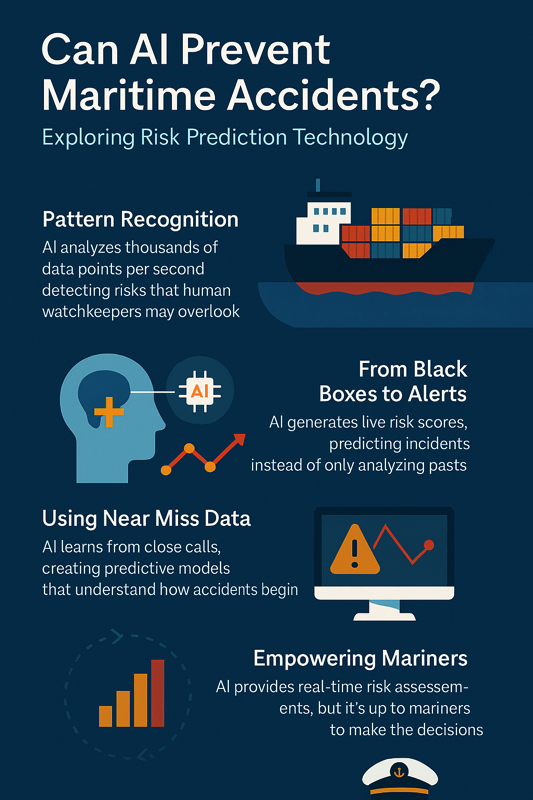
Even the most experienced officer can miss patterns when under pressure. AI doesn’t get tired or distracted. It processes thousands of data points per second — including engine vibrations, weather changes, crew shifts, and radar activity — and detects anomalies before they escalate into incidents.
In simple terms: AI sees what humans overlook. It can warn about a rising probability of fire in a specific area based on temperature and equipment stress. It can flag risky navigation behaviors based on past collisions. It learns from millions of events, not just one officer’s past.
🛠️ From Black Boxes to Living Alerts
Traditionally, we only understand accidents after they happen — with black box analysis. AI flips the model. Instead of asking “What went wrong?”, it asks “What might go wrong — and when?”
Modern risk-prediction platforms can now generate live risk scores for a ship’s condition, route, and operational context. That means captains and engineers can see not just technical alarms, but risk trends: early warnings that something is shifting out of normal.
Some systems even provide recommended actions, like reducing RPM, altering ballast usage, or reassigning crew before fatigue levels become critical.
🧠 Machine Learning and Near-Miss Data
One of AI’s greatest breakthroughs is in handling near misses. Human crews often dismiss incidents that didn’t result in damage — a close call in port, a near-slip, a sudden voltage spike. But AI treats those like gold.
Machine learning algorithms learn faster when fed large volumes of near-miss reports. Over time, they build predictive models that understand how problems begin — not just how they end.
And the more data the industry shares, the smarter these systems become.
🧑✈️ What It Means for Mariners
Let’s be clear: AI doesn’t replace the crew — it enhances it.
Mariners will still need to make the final call, especially in emergencies. But AI will give them sharper awareness, better timing, and fewer surprises. It will also reshape roles:
- Engineers will use AI dashboards to monitor failure risk.
- Bridge officers will receive behavioral feedback on ship handling.
- Safety officers will track crew health and fatigue in real time.
- Fleet managers will review risk profiles across multiple vessels daily.
In the near future, AI may become a core part of SOLAS compliance, as regulators consider how digital monitoring supports safety culture.
🚢 Final Thought
Every incident at sea has a story. But with AI, more of those stories might end with “almost happened” instead of “catastrophe.”
It’s not about removing the human element — it’s about amplifying human decision-making with powerful tools that protect life, equipment, and cargo.
The sea is unpredictable. But with AI, maybe we don’t have to be.
📬 Love all things maritime? Get exclusive stories, practical tips, and leadership insights delivered straight to your inbox—subscribe now!!!
We send out regular insights, regulation changes, and practical guides for cadets and seasoned officers alike.
Fill out the form below and stay connected with Maritime Mindshift.
📢⚓ Calling All Maritime Enthusiasts!
📝📸 Have an article, story, or photo to share? Send your submissions to contact@maritimemindshift.com and get featured on our blog!
🌊🚢 Join the crew—let’s navigate new horizons together!
“Ready to transform your maritime journey from dream to reality? Dive into De Cadete a Capitán for practical lessons, real-life stories, and the mindset you need to lead with confidence at sea. Set your course for success—grab your copy today and start charting a new future!”

Deja una respuesta